The AI Workbench

There is a shape forming around the question of how to work with AI. It hasn't fully arrived yet, but the gap between what's possible today and what most people are using is closing faster than I expected — measured in months, not years. The outlines are already clear enough to sketch.
The dominant interface today is a chat box. A single rectangle that politely asks how it can help. Walk up, ask, walk away. The interaction is shaped like a help desk, and help desks produce help-desk work — useful, often excellent, but always at arm's length. You stand on one side of the counter; the model stands on the other. Nothing of yours stays.
I don't think this is what AI looks like in the long run. I think the longer-running shape is two things stacked: a workbench on top, and a second brain underneath.
The shape of the room shapes the work
A help desk produces discrete answers to discrete questions. There's no surface on which to make anything — no place to lay out the half-finished draft, the spreadsheet you've been wrestling with, the notes from a long conversation that still need turning into something coherent.
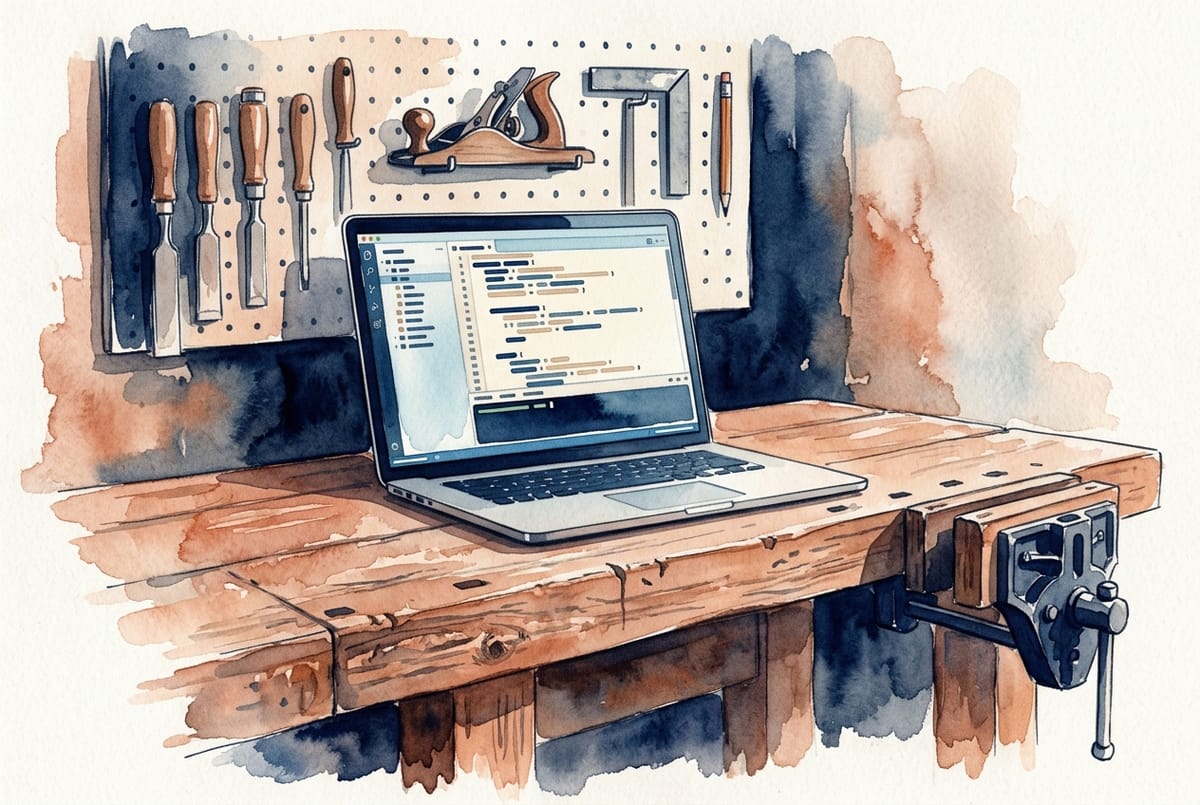
A workbench is the opposite. It's a flat surface with edges. You bring work to it. You leave the work clamped there overnight and pick it up in the morning. Tools hang on the wall behind it, in roughly the order you reach for them. Materials sit within arm's length. Nothing about the bench answers questions; it just gives the things you're making a place to be.
The shift, as it arrives, is less about choosing a different model and more about choosing a different surface.
The stations
I have a rough version of the bench on my own machine. It is patchy and provisional and will look quaint sooner than I'd like, but it already gives a sense of the shape.
When I open my laptop in the morning, the first thing I see isn't an inbox or a chat window. It's a browser tab pointed at code-server — a small editor running on a machine in another room of the house. Files on the left. A terminal at the bottom. Whatever I was working on the night before, still clamped in place.
What I'm describing has a name programmers know but most readers will not. It's called an IDE — an integrated development environment — and it's the screen software engineers spend most of their day in. A file tree down the left side. A working pane in the middle. A terminal along the bottom for running commands. The reason I'm sitting in one is not that I write much code; it's that the IDE has turned out to be the best surface I've found for working with an AI. The shape that helps a programmer hold a complex codebase in view is the same shape that helps anyone hold a complex piece of work in view.
Tools have accumulated on it, one Tuesday afternoon at a time, fixing one small irritation. Four worth sketching.
A microphone that writes. Meetings used to leave behind a small debt — the half-hour afterwards spent typing up what was actually said. Now I drop the recording onto the bench and get back a transcript with the speakers separated, the key points pulled out, and a short summary at the top. The debt is paid before I close the file.
A reader's chair. Long documents — books I want to skim before committing to, contracts, the dense PDF a service provider has just sent me — used to sit in a metaphorical pile until I had time to wade through. The bench reads them faster than I can. It pulls out the structure, summarises the parts that matter, and flags the bits I'll want to check more carefully myself. I still do the thinking. The bench just clears the underbrush.
A printing press. The blog you're reading sits in a folder full of markdown files. When a post is ready, a small script picks it up and pushes it to my Ghost site — featured image uploaded, slug set, tags attached, social-media drafts staged for me to copy across by hand. This post came off that press.
The plumbing. Less glamorous, but the bench is only as useful as the materials that arrive at it. A handful of small automations — Power Automate flows, sync rules, scheduled scripts — sit behind the scenes, shuttling files and notifications between apps so the things I want to work on actually land somewhere the bench can see them. The most boring layer on the list and probably the most important. A workbench in a room with no door isn't a workbench; it's a sculpture.
A second brain underneath
The bench is only half the picture. The interesting part is what sits beneath it.
People have been writing about a second brain for years now — an external scaffold for your own thinking, a place where notes, references, and half-finished ideas live so you don't have to keep them in your head. The familiar version is a folder of markdown files, or an Obsidian vault, or an overstuffed Notes app. At heart it is a filing cabinet, and the work of filling it has always been done by hand.
What changes when an AI workbench is bolted to that cabinet is that the cabinet stops being passive. The same notes that used to sit there waiting can be queried, summarised, joined together, surfaced when relevant. The transcript from last month's meeting doesn't have to be re-read; it can be brought back the moment its content is needed. The PDF skimmed in February doesn't have to be re-skimmed in May. The bench remembers, and the second brain stops being a storage problem and starts being a continuity.
In my own setup, this part looks unglamorous. There are small text files in the file tree of every folder telling the bench who I am, what voice to use, what conventions to follow. The files stack: a global one applies everywhere, a folder-level one adds rules for that folder, a sub-folder one adds rules for the things inside it. By the time I open a draft, the bench already knows it should use UK English, that I write with em dashes rather than brackets, that I sign off as Irfan and not as an assistant. There is also a small registry of the people I write about most often, with canonical descriptions of each, so I never have to re-explain who someone is. And there is a local memory store that persists between sessions — fragments of context the bench has found worth keeping.
None of this is exotic. It is just a year of small decisions to write things down once instead of explaining them every time.
The model is rented. The second brain is mine.
This is what will increasingly distinguish one person's AI from another's. Models are already heading toward commodity — anyone can rent the same ones, the way anyone can use the same search engine. What sets one workbench apart from another is the second brain quietly attached underneath: the documents, recordings, notes, and small rules that have accumulated in your own folders for years.
A bench made of other people's tools
The workbench, of course, is made of tools I didn't build. code-server came from a team I have never met. ffmpeg, the small program that converts audio formats so the transcriber can read them, has been quietly maintained by strangers for over twenty years. Ghost runs the blog. Anthropic trains the model. Microsoft builds the flows. I bolted them together in an arrangement that suits me, and the arrangement is the only part I can claim.
This is, I think, what tool-using has always been. The carpenter does not forge their own plane. The engineer does not derive Bernoulli's equation before each calculation. We arrange what's been left for us, add a small thing of our own where we can, and pass the bench on a little better organised than we found it.
The chat box is fine. It is just the early shape — the help desk that came before anyone had thought of building a workshop. On the other side of it, faster than I'd have guessed a year ago, a flat surface is taking form. A vice. A row of tools on the wall. Underneath, the quiet weight of everything you've ever written, ready when needed.
That's the shape I'd watch for, if anyone's asking.