Made to Measure


Most of the software we use is sold off the peg. One cut, made for everyone, which is to say made for no one in particular. You take it home and do the adjusting yourself — learn where the menus hide, accept the order it wants things done in, fill out the form the way the form prefers to be filled. The fit is never quite right, but you stop noticing, the way you stop noticing a collar that has always been a half-size too big. You assume that is simply what wearing a tool feels like.
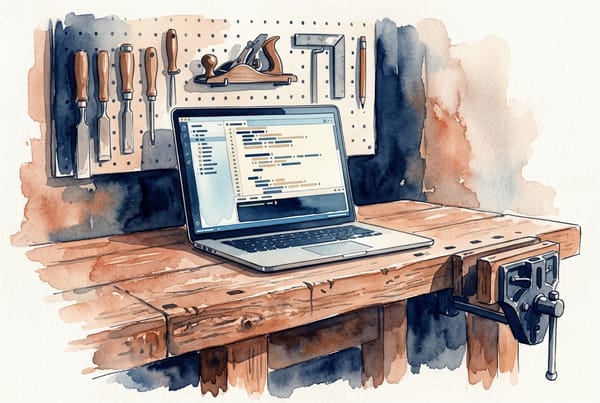
I want to describe a different fit. Picture an engineer — though it could be anyone whose work is mostly thinking — whose tools have spent a year being taken in, a seam at a time, until the working day fits like a suit cut for one body. Not bought that way. Tailored, slowly, by use.
The day is already warm
Their morning doesn't start at the screen. It starts with a run, a coffee, a desk at home that faces the right way. By the time they sit down, the work is already waiting — and waiting in the exact shape they left it the night before. No cold lobby, no home screen asking where they'd like to begin. The half-finished thing is still clamped in place, mid-sentence, exactly as abandoned.
The laptop itself barely matters. It is a pane of glass onto a machine humming in another room, where all the real work actually lives — the notes, the running threads, the small accumulated rules. They could open the same day from any screen in the house and find it identical. The device is incidental. The fit is not.
The list that learned the rhythm
The first thing they reach for is a list. Not a list they wrote — a list that assembled itself overnight from everything still outstanding, and then, more usefully, ordered itself. The heavy thinking sits at the top, because this person does their best lifting in the morning. The small, fiddly, low-stakes jobs have been set aside for the late afternoon, when the light goes flat and so does their concentration.
Nobody configured this. There was no settings page where they ticked a box marked big tasks first. The list simply watched how the work actually got done, month after month, and arranged itself to match.
This is the part worth pausing on. Off-the-peg productivity tools arrive with a method baked in — clear the inbox, eat the frog, whatever the manual prescribes — and the job is to contort your habits until they fit the method. This one did the opposite. It noticed the method that was already there, the one this person had been using without quite naming it, and quietly bent itself around it.
A brief in your own idiom
There are conversations lined up through the day. Before each one, a short brief is waiting — not the bland summary anyone would get, but the version pitched at what this particular person tends to want to know before walking in. It has learned what they skip and what they dwell on. It reaches back into things said and read months ago, pulls out the threads that bear on the conversation ahead, and lays them out in the shorthand this person actually uses. Another seam, taken in.
Afterwards, what was said doesn't evaporate. The points that mattered and the threads worth picking up later are folded back into the same growing store of context, so that the next time the subject comes round, it is already warm. The memory being built is not a generic one. It is shaped to this person — their projects, their people, their way of referring to things — and it compounds. Every conversation makes the next brief a little sharper.
Dusk
By the time the afternoon dims, the easy things are all that's left, and that is no accident. The small jobs that need doing but not much thinking were held back, deliberately, for the tired end of the day. The day was shaped to fit the person — not, as it has always been before, the person flattened to fit the day.
None of the individual pieces are miraculous. A list, a brief, a store of notes. What's quietly remarkable is the direction of the fit.
The direction of the fit
For the whole history of tools, the adapting ran one way. We learned QWERTY because the machine preferred it. We memorised the shortcuts. We bent our habits around the software's assumptions and called the bending getting good at the tool. The new thing — the thing that still surprises me when I watch it happen — is a tool that bends back. And keeps bending, a little more each day, the way a good tailor takes in another half-inch every time you visit.
There is a catch, and it is worth naming. A suit cut this closely fits exactly one person. It doesn't transfer. Sit someone else down at this day and most of it would feel subtly wrong — the list ordered by a rhythm that isn't theirs, the briefs pitched at the wrong questions. And you feel the fit most sharply in its absence: on a borrowed machine, on a fresh account, in front of the off-the-peg defaults everyone else is still wearing. The better the fit, the more naked you feel without it.
Off the peg, you adjust the suit to the body by adjusting the body. Made to measure, the suit is cut to remember the body instead. After a long stretch of wearing tools that asked us to do all the remembering, that's the part I'd watch — the tools, at last, learning to remember us.